
Executive and VIP Programmes
CEOs, board members, official guests, and Private Offices may follow agendas where the hotel, Mobility, meetings, FBO, and subsequent activities must remain perfectly connected.
HOTELS · HOSPITALITY PARTNERS · OPERATIONAL COORDINATION
A hotel can represent much more than an accommodation facility within a complex programme. In these contexts, Hospitality Programme Coordination involves connecting what happens within the facility with external components on which the programme depends.
It can become a point of arrival, a place of hospitality, a base for executives and delegations, a meeting venue, a component of an event, an interface with Mobility, Private Aviation, Security, and other operators.
When these components become interdependent, coordination no longer concerns only the internal activities of the facility.
Havermond works in conjunction with hotels, hotel groups, and Hospitality Partners when corporate, executive, Private Office programmes, events, or Multi-Location operations require a level of Operational Coordination capable of connecting the facility to the overall programme.
The hotel fully retains responsibility for its own management and the services provided.
Havermond oversees the interdependencies included in the mandate between the Hospitality Programme, guests, stakeholders, Mobility, and other external components.
The hotel continues to manage its own operations. Havermond coordinates the point at which those operations must integrate with a broader programme.
01
Not every stay or event requires an external level of Operational Coordination.
The need arises when what happens within the facility has consequences for activities, operators, and stakeholders external to the hotel.
CEOs, board members, official guests, and Private Offices may follow agendas where the hotel, Mobility, meetings, FBO, and subsequent activities must remain perfectly connected.
Congresses, conventions, corporate events, and MICE programmes can involve rooming, hospitality, venue, Guest Movement, and different operators.
An arrival via Private Aviation can generate interdependencies between Aviation Inputs, FBO, Ground Mobility, the hotel, and the programme at the destination.
Delegations or events can distribute guests across multiple facilities, requiring continuity between hospitality, information, and the programme.
The hotel may represent only one phase of a programme developed over several days, cities, or countries.
02

When a property is part of a complex programme, an increasing portion of coordination can fall to General Managers, Guest Relations, Sales, Events or Front Office.
The Havermond model introduces a dedicated oversight for external interdependencies included in the mandate.
Guests, agenda, Mobility, events, venue and subsequent activities are viewed within the same operation.
The hotel does not necessarily have to become the central point of connection between every agency, operator, Executive Office or external entity involved.
Relevant updates are transferred to the functions that genuinely require them for their role.
The property maintains its hotel operations; Havermond coordinates the interdependencies assigned to its mandate.
A variation concerning guests, arrivals, agenda or external activities is evaluated against its consequences for other components.
03

Havermond does not introduce a second hotel management structure.
The mandate starts from the existing configuration and exclusively identifies the relationships that require coordination beyond the property's normal operational perimeter.
The assessment may consider:
From this framework, it is defined where coordination remains within the hotel and where it is beneficial to introduce cross-functional oversight.
04

High-end hotels can become part of programmes where hospitality and executive agendas are closely interdependent.
The stay can be linked to:
Havermond maintains the connection between the hotel and the Mobility Programme within the scope defined by the mandate.
The establishment continues to manage the stay and the hotel's own services.

05
Family Offices and Private Offices can utilise hotels and hospitality facilities within more complex private programmes.
In these contexts, Havermond can operate between:
The hotel remains responsible for hospitality services.
Havermond maintains coordination of interdependencies with the overall programme.
06

Conventions, congresses, corporate meetings, and delegations can transform the hotel into one of the central infrastructures of the programme.
The facility can simultaneously be:
Havermond can maintain the link between the Hospitality Program and:
This coordination does not replace a PCO, DMC, or agency.
07

When guests are distributed across multiple properties, complexity increases.
Different hotels may have:
Havermond can maintain a common framework for the interdependencies included in the mandate, while preserving the specificity of each property.
The objective is not to standardise the hotels.
It is to keep information, Guest Movement, and subsequent activities consistent with the overall programme.
08

The interface between hotel and Mobility is particularly sensitive in complex programmes.
An arrival change can impact:
Similarly, a change in the agenda can alter departure times, Guest Movement, or planned activities at the venue.
Havermond coordinates this interface without overlapping the responsibilities of the hotel and Mobility operator.

09
When executives or guests reach their destination via Private Aviation, Aviation Inputs can have direct consequences on the hospitality programme.
The model can connect:
AVIATION INPUTS ↓ FBO / AIRPORT INTERFACE ↓ GROUND MOBILITY ↓ HOTEL ↓ DESTINATION PROGRAM
Havermond receives relevant updates from Aviation stakeholders and coordinates the implications for the destination components included in the mandate.
The hotel does not need to oversee the aeronautical process.
Flight Department, Aviation Operator, FBO, and Ground Handler retain their respective responsibilities.
10

Programmes involving executives, VIPs, or guests subject to specific Security Requirements may necessitate structured coordination between:
Security defines the protection framework.
The hotel retains its responsibilities related to the property.
Havermond coordinates the Mobility and operational components included in the mandate so that they can function consistently with the communicated requirements.
11

In some assignments, the hotel is a central component of the destination programme.
It does not simply represent the place where the guest stays.
It can become:
The relevance of each function depends on the programme.
Havermond maintains liaison with the other components to ensure that what happens within the property remains consistent with what needs to occur externally.
12
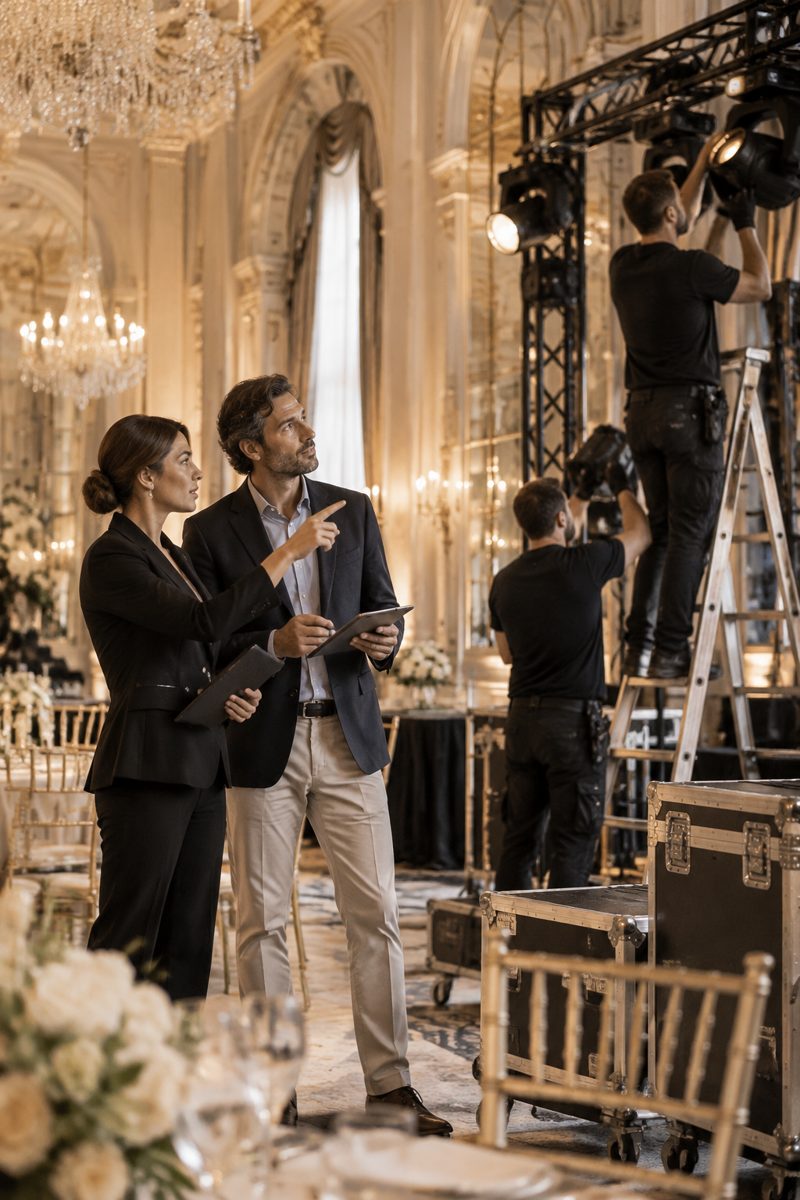
Hotels and resorts can host events involving agencies, production companies, brands, and external operators.
In these cases, the venue retains responsibility for its spaces and services, while other parties oversee production, the event, or the programme.
Havermond can intervene at the Operational Coordination level when it is necessary to maintain the connection between:

13
In certain contexts, the relationship between a hotel and an external programme may require a broader oversight of operational interdependencies.
When the complexity exceeds the simple coordination between the hotel and the external programme, the mandate can extend to a broader level of Hospitality Operations Coordination.
The model delves into:
The responsibility for hotel management remains with the operator and management.
14

Hotel groups, operators, or asset owners can manage distributed programmes across different properties.
A single client or programme can span:
HOTEL A → CITY B → HOTEL B → EVENT → CITY C
with different operators, procedures, and teams.
Havermond can maintain continuity between:
Local specificities remain within the property.
15

Hotels and hospitality partners may go through phases where the number of interdependencies temporarily increases.
Openings, re-openings, repositioning, brand changes or operator changes may require coordination between:
When the mandate concerns the future configuration of the asset, the in-depth analysis is developed within the Hospitality Assets & Repositioning area.
16

A complex hospitality programme can generate information from:
Not all information needs to be shared indiscriminately.
The framework can define:

17
The presence of multiple parties can generate decisions belonging to different levels.
Some fall under the General Manager's remit.
Others belong to the operator, the ownership, the agency, the client, or specialist structures.
Havermond can clarify:
This helps to reduce overlaps without altering the hotel's inherent responsibilities.
18
In complex hospitality programmes, a variation can quickly cascade through multiple components.
A new arrival time can alter hospitality and Mobility.
A change in the Run of Show can impact departure from the hotel.
A Security decision can modify access and timings.
Operational Continuity maintains consistent information, decisions, responsibilities, and execution as the programme evolves.
The programme may change. The relationship between the hotel and the overall operation must remain manageable.
19

Havermond can coordinate with departments such as:
Not all of them necessarily need to be included in the mandate.
The scope is defined according to the interdependencies actually relevant to the programme.

20
Hotels & Hospitality Partners requires a clear distinction between hotel management, hospitality services, and external Operational Coordination.
General Managers, hotel operators, and management companies retain responsibility for property management.
Individual departments retain responsibility for their respective functions.
Event agencies, PCOs, DMCs, and production companies retain responsibility for the activities entrusted to them.
Mobility, Aviation, and Security operators retain their respective specialist responsibilities.
The client retains the decision-making levels stipulated by the programme.

21
Not every relationship between a hotel and a client requires a Havermond mandate.
The necessity increases when hospitality, guests, Mobility, events, and external facilities become mutually dependent.
The preliminary assessment may consider:
From this framework, the level of Operational Coordination required to connect the facility to the Hospitality Program and other components included in the mandate is defined.
The model can integrate with existing management, teams, and operators without necessarily altering their responsibilities and procedures.